
Floating TV Stands in Kenya: Wall-Mounted Units, Prices & Installation
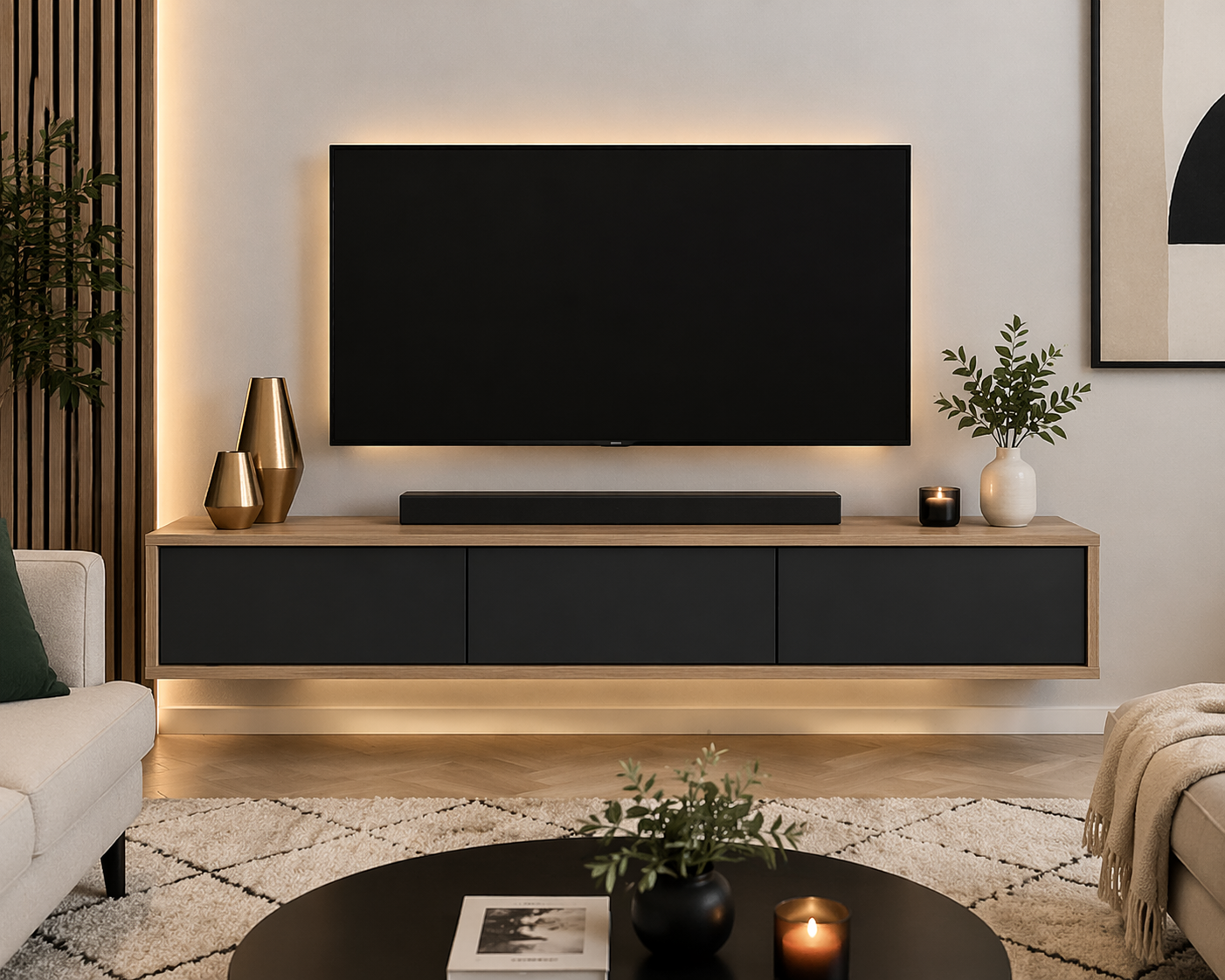
A floating TV unit is the single quickest way to make a small Kenyan living room feel bigger. With nothing standing on the floor, the eye reads the full depth of the room, cleaning underneath takes seconds, and the whole TV wall looks deliberate rather than furnished.
The catch is that a floating unit is only as good as the wall it hangs on — and that is exactly the part most buyers and most sellers skip. This guide covers the designs available here, which Kenyan walls can take one, how high to mount it, cable management, real prices, and who should not buy one at all.
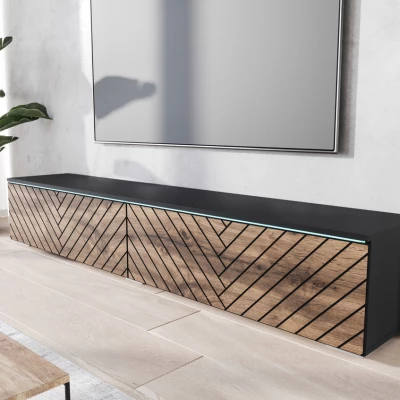
Nothing on the floor: a wall-mounted unit leaves the full depth of the room visible.
What is a floating TV stand?
Structurally it is a cabinet without legs, carried entirely by brackets or a mounting rail fixed into the wall. Everything else — drawers, flip-down doors, open cubbies for the decoder — works exactly as it would on a standing unit.
Four things make them popular here:
- The room looks bigger. Visible floor under the unit reads as extra depth — the same trick raised legs achieve, taken further.
- Cleaning is easier. No legs to sweep around, and no gap behind furniture where dust collects.
- The TV wall looks planned. Screen above, console below, nothing interrupting the line.
- It suits narrow rooms. Floating units tend to be shallow, so they intrude less into a tight sitting room.
Floating or standing: which should you choose?
| Floating (wall-mounted) | Standing (legged) | |
|---|---|---|
| Floor space | Frees it entirely | Occupies it |
| Room feel | Larger, more open | More grounded, traditional |
| Installation | Drilling and fixings required | Place and go |
| Wall required | Solid, or a prepared partition | None |
| Moving it later | Leaves fixing holes | Just lift and move |
| Weight it carries | Limited by the fixings | Limited only by the build |
| Suits renters? | Often not | Yes |
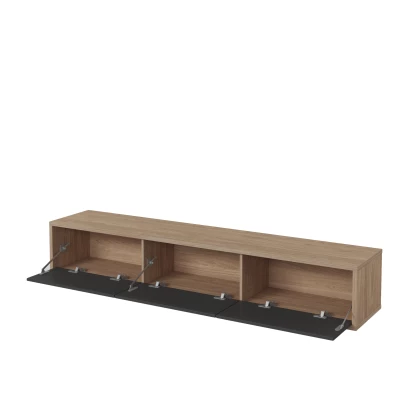
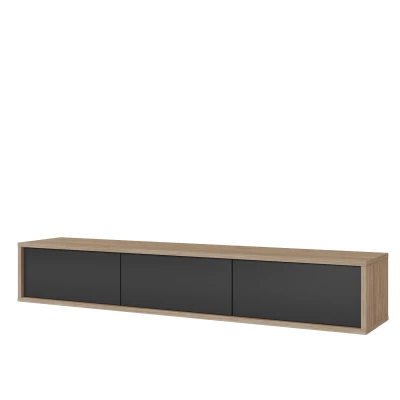
Concealed storage behind the panels, and a clear top surface — the floating format in detail.
If you decide a standing unit suits you better, our guide to wooden TV stands in Kenya covers designs, timbers and sizing.
Will your wall take it? The question most buyers skip
This is the section that decides whether a floating unit is a good buy or an expensive mistake, and it is almost never discussed at the point of sale.
| Wall type | Common in | Verdict |
|---|---|---|
| Concrete block / masonry | Most Kenyan houses, maisonettes, older flats | Ideal — takes proper anchors securely |
| Poured concrete | Structural walls in apartments | Excellent, but needs a hammer drill |
| Gypsum / plasterboard partition | Newer apartment internal walls, subdivisions | Only if fixed into the frame behind |
| Timber-framed partition | Some conversions and offices | Workable — fix into the studs |
How to tell which you have: knock on it. A solid, dull thud with no echo means masonry or concrete. A hollow, drum-like sound means a partition wall with a cavity behind, and you need to find the frame before drilling anything.
Standard plasterboard anchors are rated for pictures and light shelves, not a loaded media console. A unit holding a decoder, soundbar and console pulls downward and outward on every fixing. On a hollow wall, fix into the frame behind, or have a timber batten fitted across the studs first and mount to that. If in doubt, ask an installer before you buy.
How high should you mount it?
Because a floating unit can be fixed at any height, people often mount it too high. Two rules keep it right:
The console. Treat it as a piece of furniture, not a shelf. Around 40–55cm from the floor to the top surface puts it at the same height a standing console would be, which is what keeps the room looking normal rather than oddly elevated.
The screen. The centre of the TV should meet your eyeline when seated on the sofa — not the top of the screen, the centre. Then leave a hand’s width of clearance between the console and the screen for a soundbar, decoder or cable run.
For the full sizing picture — how long the unit should be relative to your screen — see our TV stand size guide.
Cable management on a floating unit
This is the practical downside nobody mentions until the unit is up. On a standing stand, a dangling cable disappears behind the furniture. On a floating one, it hangs in mid-air against a clean wall, and it will be the first thing you see.
Three ways to deal with it, best first:
| Method | Result | Best done |
|---|---|---|
| In-wall conduit | Completely invisible cables | During a build or TV wall installation |
| Surface trunking | Neat channel, paintable to match | Retrofit on a finished wall |
| Cable box on the console | Hides the mess, not the run | Quick fix, no wall work |
If you are planning the whole wall rather than just the console, our TV wall design service handles concealed cabling, panelling and the built-in unit together, with a site measurement before anything is fixed.
Floating TV stand sizes
Sizing follows the same rule as any TV unit: the console should be wider than the screen. As a guide, a 5ft (about 150cm) unit suits screens up to roughly 55 inches, while 180cm and above comfortably carries a 65-inch television.
| Unit length | Suits TV up to | Typical room |
|---|---|---|
| 5ft (~150cm) | ~55″ | Apartment sitting room |
| 6ft (~180cm) | ~65″ | Most family living rooms |
| 180cm+ | 65–75″ | Larger or open-plan rooms |
Floating TV stand prices in Kenya (2026)
| Unit | What you get | Price (KES) |
|---|---|---|
| 180cm wall-mounted cabinet | Flip-down doors with an open shelf | 18,000 |
| Wood-tone floating console | Flush closed storage plus an open media cubby | 19,000 |
| Walnut floating, rattan arch fronts (5ft) | Arched woven-look panels, closed storage | 22,000 |
| Charcoal floating, closed storage | Long low profile with slotted front sections | 65,000 |
| Custom floating unit | Built to your wall length and finish | Quoted |
For context, marketplace floating stands in Nairobi start around KSh 4,500, with 6ft units advertised near KSh 16,000. Those figures are real, but the gap is in board thickness, bracket quality and finish — the three things that decide whether a wall-mounted unit still looks level after a year of holding a soundbar.
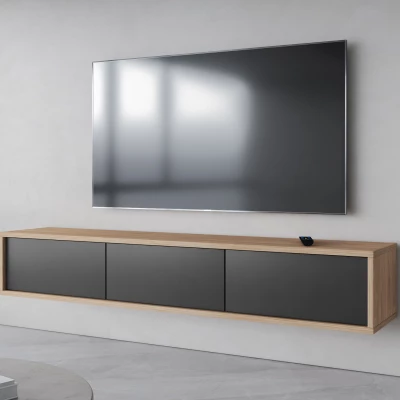
A long floating unit becomes the architecture of the TV wall rather than furniture against it.
Installation: what to expect
The sequence is straightforward, but each step matters — a floating unit that is 5mm out of level is obvious the moment anything is placed on it.
- Identify the wall type — knock for solid versus hollow, and locate the frame if it is a partition.
- Mark and level the bracket line, checking the height against your seating and screen position.
- Drill and anchor using fixings suited to that wall — masonry anchors for block, frame fixings for partitions.
- Mount the unit and check it is level before loading anything onto it.
- Run the cables through conduit or trunking, then place the equipment.
Monsoon delivers free within Nairobi and provides installation support. Because wall-fixing depends entirely on your wall type, confirm the arrangement for your specific unit and wall on WhatsApp before ordering — it takes one message and avoids the most common problem in this category.
Who should not buy a floating TV stand
Being straightforward about the misfit cases saves money and wall repairs:
- Renters. Fixing holes are hard to hide when you leave, and many tenancies restrict drilling.
- Unprepared hollow walls. Without reaching the frame behind, the fixings are not safe under load.
- Heavy equipment. A large amplifier or stacked kit is better carried by a floor-standing unit.
- Frequent rearrangers. A floating unit commits you to one wall until you patch and repaint.
- Homes with young children where a low, solid, floor-standing unit may simply be more practical.
If any of those apply, a standing console with raised legs gives much of the same visual lightness without the commitment — and if you are weighing materials as well, our solid wood versus MDF comparison covers what lasts.
Get the floating look, fitted properly
Send a photo of your TV wall on WhatsApp — tell us whether it’s block or partition — and we’ll advise which floating unit suits it, or build one to your wall length. Free delivery within Nairobi.
Frequently asked questions
How much is a floating TV stand in Kenya?
Floating TV stands from Monsoon cost KSh 18,000–65,000 in 2026. A 180cm wall-mounted cabinet starts at KSh 18,000, wood-tone floating consoles run KSh 19,000–22,000, and a large charcoal floating unit with closed storage reaches KSh 65,000. Lighter marketplace units start near KSh 4,500.
Can a floating TV stand hang on a gypsum wall?
Not on plasterboard fixings alone. On a gypsum or partition wall the brackets must be anchored into the timber or metal frame behind, or a support batten fitted across the studs first. Knock the wall: a hollow, drum-like sound means a cavity, and you must locate the frame before drilling.
How high should a floating TV console be mounted?
Mount the console so its top sits about 40–55cm above the floor — roughly the height of a standing unit — with the TV centred at seated eye level above it. Leave 10–15cm between the console top and the bottom of the screen for a soundbar, decoder and cable access.
Are floating TV stands strong enough?
Yes, when fixed correctly into a solid wall or into the frame of a partition wall. Strength comes from the fixings and the wall rather than the unit itself, which is why wall type matters more than the cabinet. For very heavy equipment, a floor-standing console remains the safer choice.
Monsoon prices current at August 2026 and subject to change; several items are promotional. Marketplace comparison figures are typical Nairobi listing prices, not Monsoon products. Wall, fixing and height figures are general guidance — confirm the right fixings for your specific wall and unit with your installer before drilling.

Add a review
Your email address will not be published. Required fields are marked *