
Solid Wood TV Stand for a 55″, 65″ or 75″ TV: Kenya Size Guide
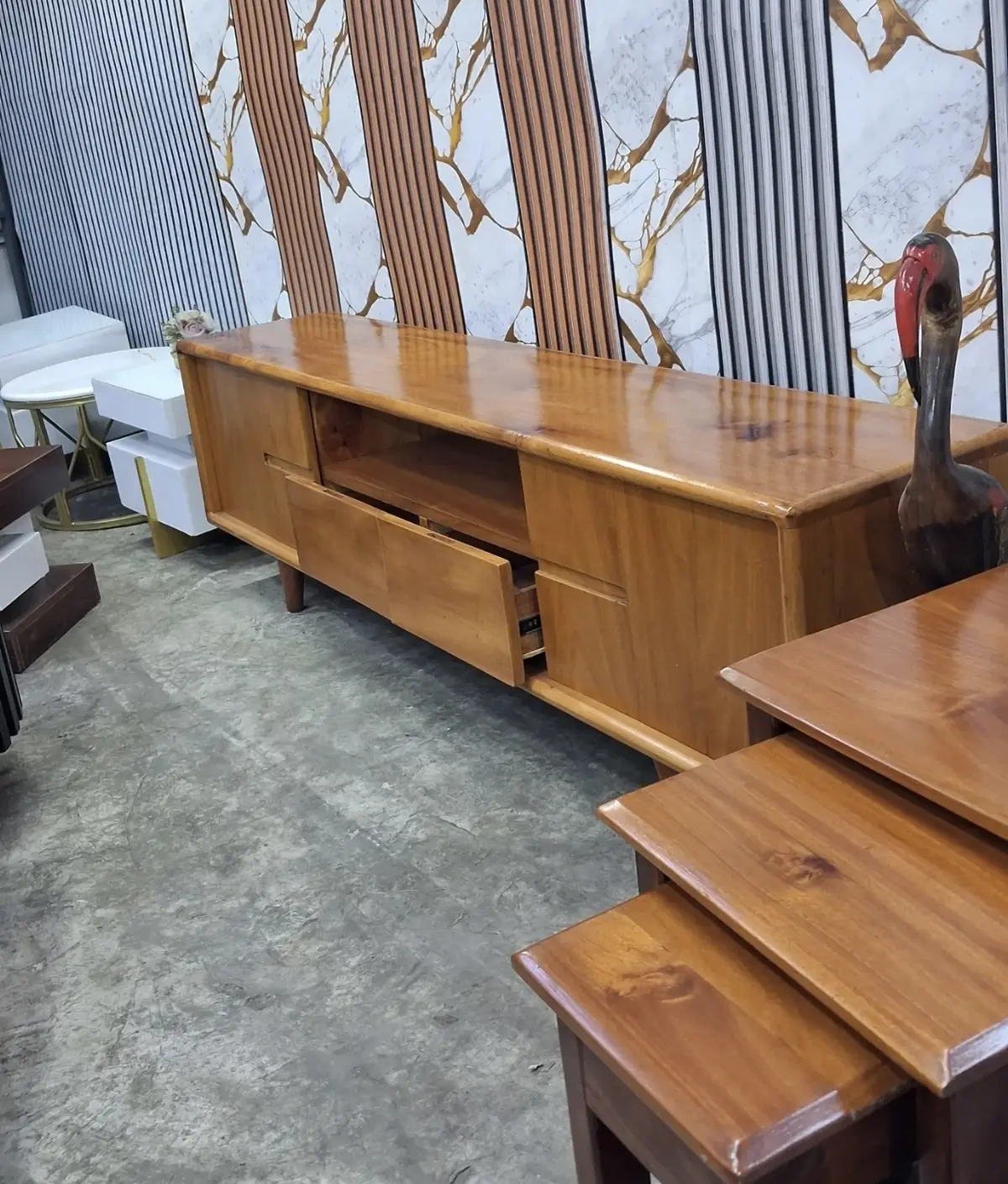
A solid wood TV stand is an investment, so getting the size right the first time matters. Too small and a big screen looks perched and unstable; too large and it swamps the wall. This guide gives the exact stand length for every popular TV size in Kenya, plus the height and depth rules that make a large screen look anchored.
What size solid wood TV stand for my TV?
The single rule that governs everything: the stand must be wider than the TV. A screen that overhangs its stand looks top-heavy and, on a real TV with a central or two-foot base, can actually be unstable. Aim for at least 15cm of clear stand on each side of the screen.
Crucially, measure the TV's full width — the whole body of the television — not the diagonal "55-inch" screen figure. A 55″ TV is roughly 123cm wide; a 65″ about 145cm; a 75″ about 167cm. Add your 15cm each side and you get the minimum stand length.
| TV size | Approx. TV width | Minimum stand length | Ideal stand length |
|---|---|---|---|
| 32″ | ~73cm | ~100cm | 120cm |
| 43″ | ~96cm | ~125cm | 120–150cm |
| 50″ | ~112cm | ~140cm | 150–180cm |
| 55″ | ~123cm | ~150cm | 160–200cm |
| 65″ | ~145cm | ~175cm | 200cm+ |
| 75″ | ~167cm | ~197cm | 200–240cm |
These are the sizes we build most solid wood stands at — 180cm and 200cm units carry the 55″ and 65″ screens most Kenyan families own. For the full material and design picture, see our pillar guide to wooden TV stands in Kenya.
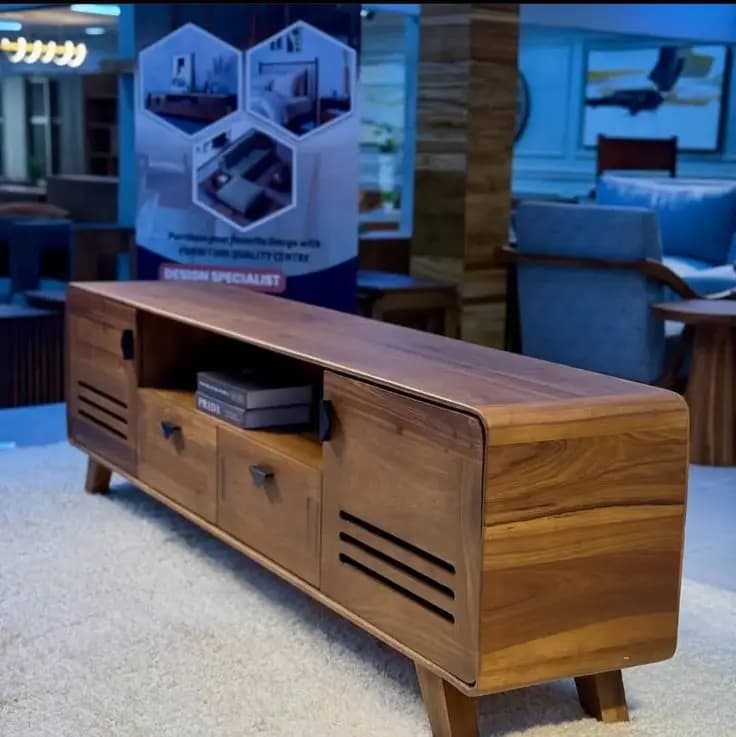
The stand sits clear of the screen on both sides — the difference between anchored and perched.
What height should a TV stand be?
Height is about comfort, not just looks. Seated on a normal sofa, your eyeline should fall on the centre of the screen — if you're tilting your head up or down, the stand is the wrong height. For most Kenyan sofas, a stand of around 45–60cm gets a 55–65″ screen's middle to eye level.
The modern trend is lower, long "media unit" stands around 45cm high, which suit low contemporary sofas. If your seating is higher, or the room is large and you sit further back, a slightly taller unit works better.
How deep and how much storage?
Depth is often overlooked. A stand around 40–45cm deep comfortably holds a modern TV's feet and leaves room behind for cables and a soundbar. Too shallow and the TV base overhangs; too deep and it eats the room.
Storage is where a solid wood stand earns its keep. Drawers and cabinets hide the decoder, router, remotes and the cable tangle that makes a TV wall look messy. A larger screen usually means more boxes — so size the storage up with the screen. The same coordinate-and-declutter thinking runs through our guide to TV stand and coffee table sets.
Before you order, measure three things: the wall the stand will sit against, the full width of your TV, and the distance from your sofa. A stand that fits the TV but not the wall — or dwarfs a small room — is the most common sizing regret. Size up for the screen, but stay in proportion to the wall.
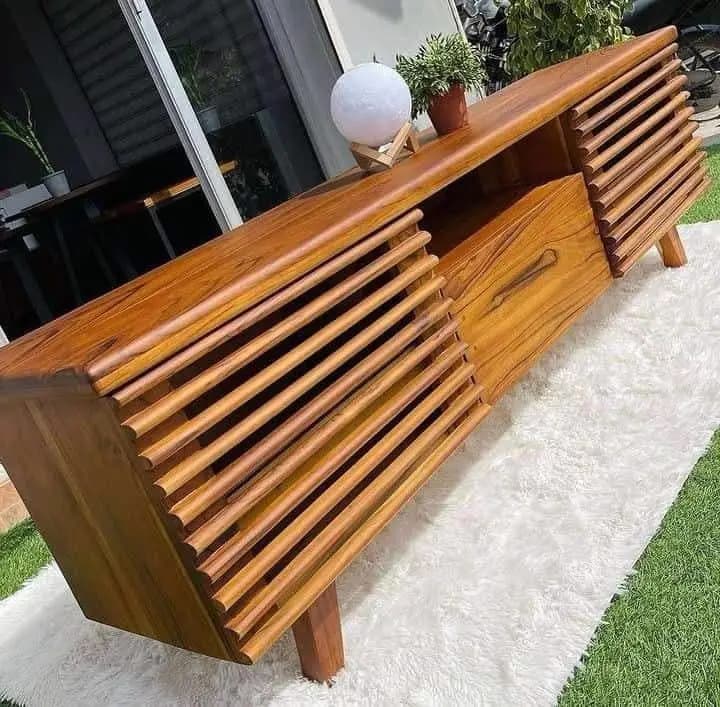
Drawers and cabinets hide the decoder, router and cables — the storage a bigger screen needs.
Common TV stand sizing mistakes
Four mistakes account for almost every "it doesn't look right" TV wall in Kenya:
1. A stand narrower than the TV. The most common of all. The screen overhangs the ends, looks top-heavy, and on some TVs the feet don't even fit. Always go wider than the screen.
2. Using the inch figure as the width. A "55-inch" TV is not 55 inches wide — that's the diagonal. Its body is about 123cm. Buying a 130cm stand thinking it's "much bigger than 55" leaves almost no clearance. Measure the actual width.
3. Mounting or placing the screen too high. A screen whose centre sits above your seated eyeline strains the neck. Match the stand height so the middle of the TV lands at eye level from the sofa.
4. Not measuring the wall. A stand sized perfectly for the TV can still be wrong for the room — too long for the wall, or lost on a large one. Measure the wall span first, then fit the TV rule inside it.
If your TV is wall-mounted above the stand, the stand no longer needs to be wider than the screen for stability — but for looks, keep it at least as wide as the TV so the two align. A stand much narrower than a mounted screen above it looks unbalanced.
Custom sizing for odd walls and big screens
Standard sizes suit most rooms, but not all. A very wide wall, a 75″+ screen, an alcove, or a specific storage need is where a custom stand wins — built to the exact length, depth and height your room calls for, in the wood you want. For the full options, see our guide to custom hardwood TV stands in Kenya, or if you're still weighing materials, our solid wood vs MDF comparison.
The right size, in solid wood
Tell us your TV size and wall length on WhatsApp and we'll match — or build — a solid wood stand sized exactly right, from KSh 35,000. Delivered across Nairobi and Kenya.
Frequently asked questions
What size TV stand for a 65-inch TV?
For a 65-inch TV — about 145cm wide — choose a stand of 200cm or more, giving at least 15cm clear on each side so the screen looks anchored. A 175cm stand is the absolute minimum. Measure your TV's full width, not the 65-inch screen figure, and size up rather than down.
Should a TV stand be wider than the TV?
Yes. A TV stand should always be wider than the television — ideally 15cm clear on each side. A stand narrower than the screen looks top-heavy and can be unstable with a real TV's base. Width first: measure the TV's full body width, add 15cm each side, and that's your minimum stand length.
How high should a TV stand be?
A TV stand should place the centre of the screen at your eye level when seated — usually a stand of about 45–60cm for a normal sofa 2.5–3m away. Low, modern media units around 45cm suit contemporary low sofas; taller units suit higher seating. Aim your eyeline at the middle of the TV, not the top.
Can I get a solid wood stand for a 75-inch TV?
Yes. A 75-inch TV (about 167cm wide) needs a solid wood stand of 200–240cm. At this size, solid hardwood is the safer choice — it carries the weight without sagging. A custom stand built to your wall length and screen is ideal for large screens, from around KSh 35,000 depending on size and wood.

Add a review
Your email address will not be published. Required fields are marked *