
Wooden Shoe Racks in Kenya: Designs, Wood Types & Prices (2026)
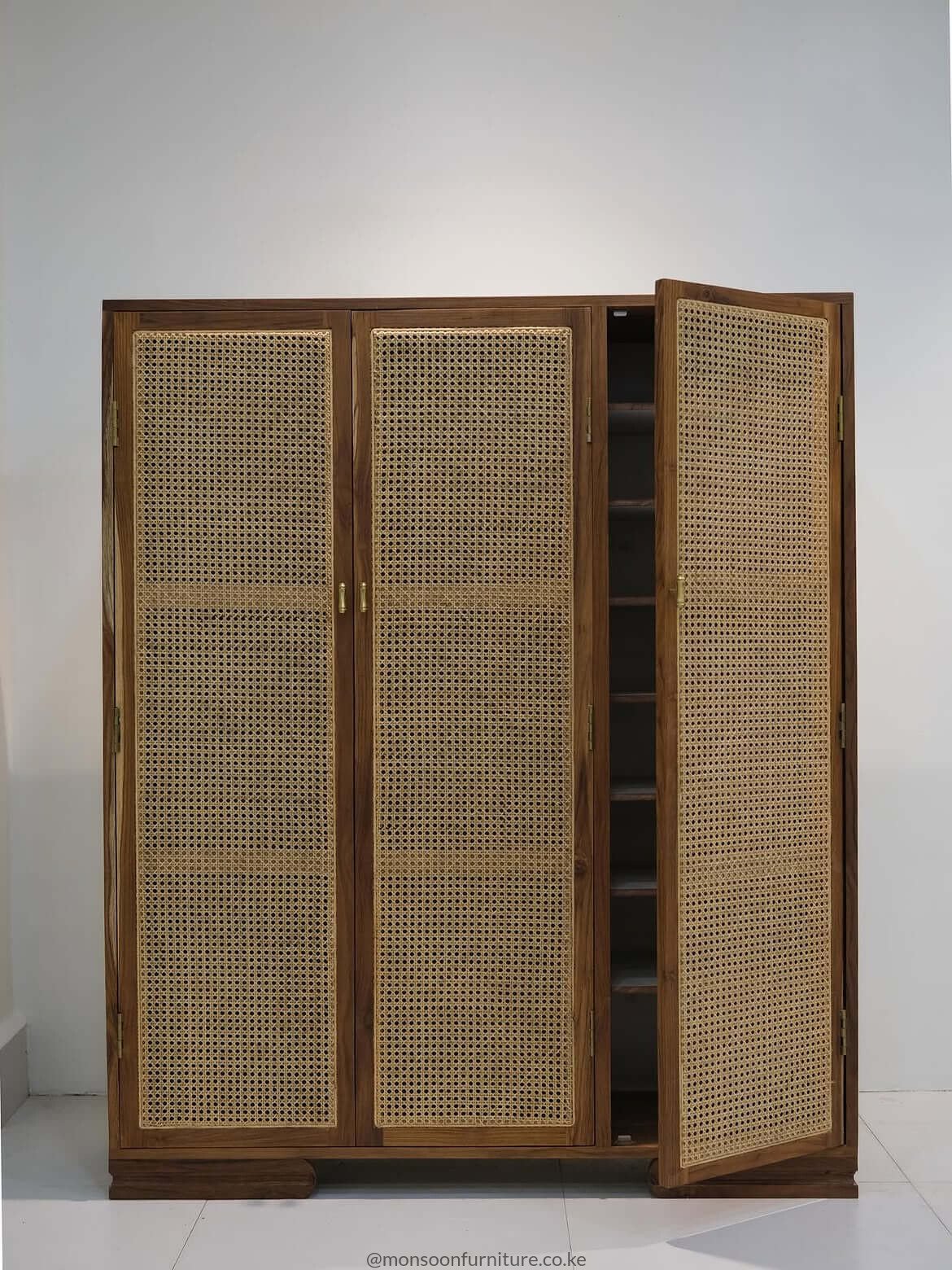
Wood is what turns a shoe rack from a utility item into furniture. A wire frame does the same job for a tenth of the price, but it announces itself as storage; a wooden cabinet by the front door simply looks like part of the house. That is why wooden racks dominate the middle and upper end of the Kenyan market.
This guide covers the wooden shoe rack designs available here, which timbers actually last in Kenyan conditions, real 2026 prices, and — the part most buyers need most — how to tell genuine wood from a convincing wood-look finish before you pay for it.
Why choose a wooden shoe rack?
Three practical advantages separate wood from the cheaper alternatives:
- It holds the load. A shelf carrying eight or ten pairs is under constant weight. Timber shelves stay flat where thin wire and light plastic bow within a season.
- It looks like furniture. An entryway is the first thing guests see. A wooden cabinet finishes that space; a wire rack advertises the clutter it holds.
- It can be repaired. Scuffs and knocks in an entryway are inevitable. Real timber can be sanded and re-oiled — a damaged board or plastic unit simply gets thrown away.
For the full comparison across every material and rack type, see our main guide to shoe racks in Kenya.
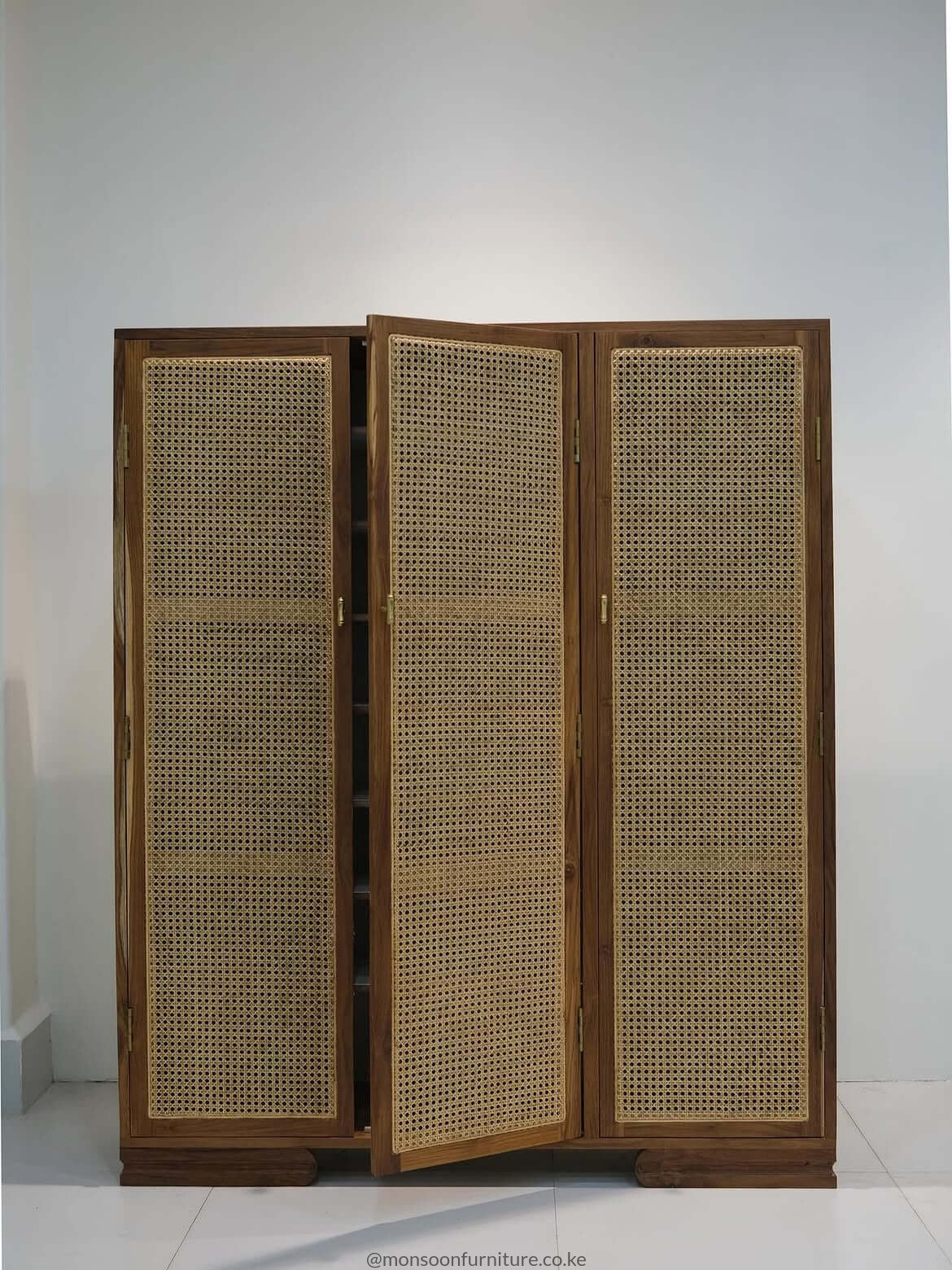
Warm teak with brass-tone hardware — storage that reads as a piece of furniture, not a utility rack.
Wooden shoe rack designs in Kenya
Wood is worked into five broad formats, each solving a different problem:
| Design | What it looks like | Best for |
|---|---|---|
| Open tiered rack | Timber shelves on an open frame | Daily shoes; airing damp footwear |
| Woven / cane-door cabinet | Solid frame, woven panel inserts | Hiding shoes while keeping airflow |
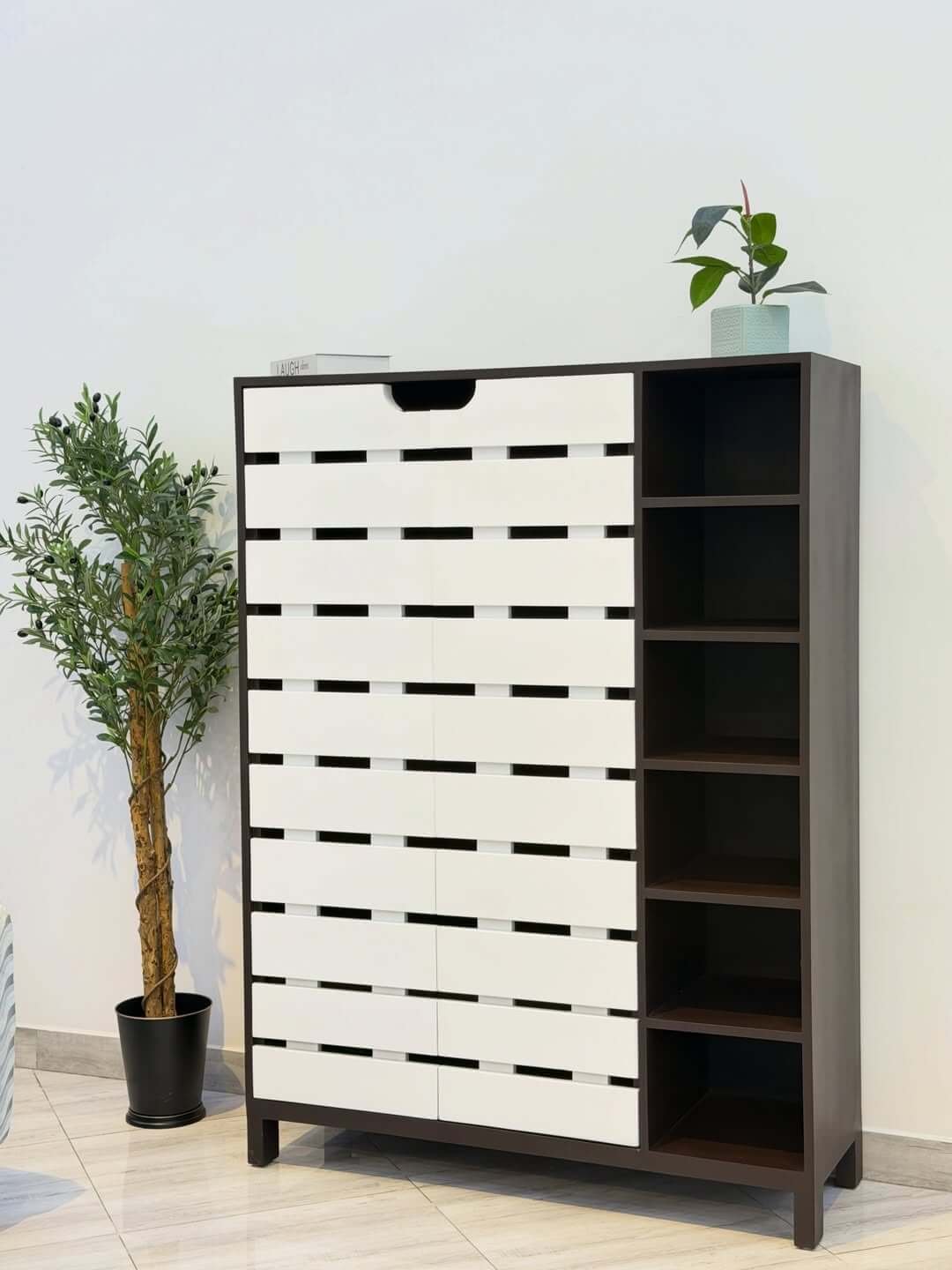
| Slatted-front cabinet | Horizontal slats across the doors | A modern look with built-in venting |
| Tilt-out bin unit | Compartments that pivot forward | Narrow hallways — very slim depth |
| Bench with storage | Seat above, shoe shelves below | Entryways where you sit to change |
Woven and cane fronts have become the signature look, and there is a practical reason beyond fashion: the weave lets air move through a closed cabinet, which matters more in Kenya than in cooler climates. Slatted fronts do the same job in a more geometric style.
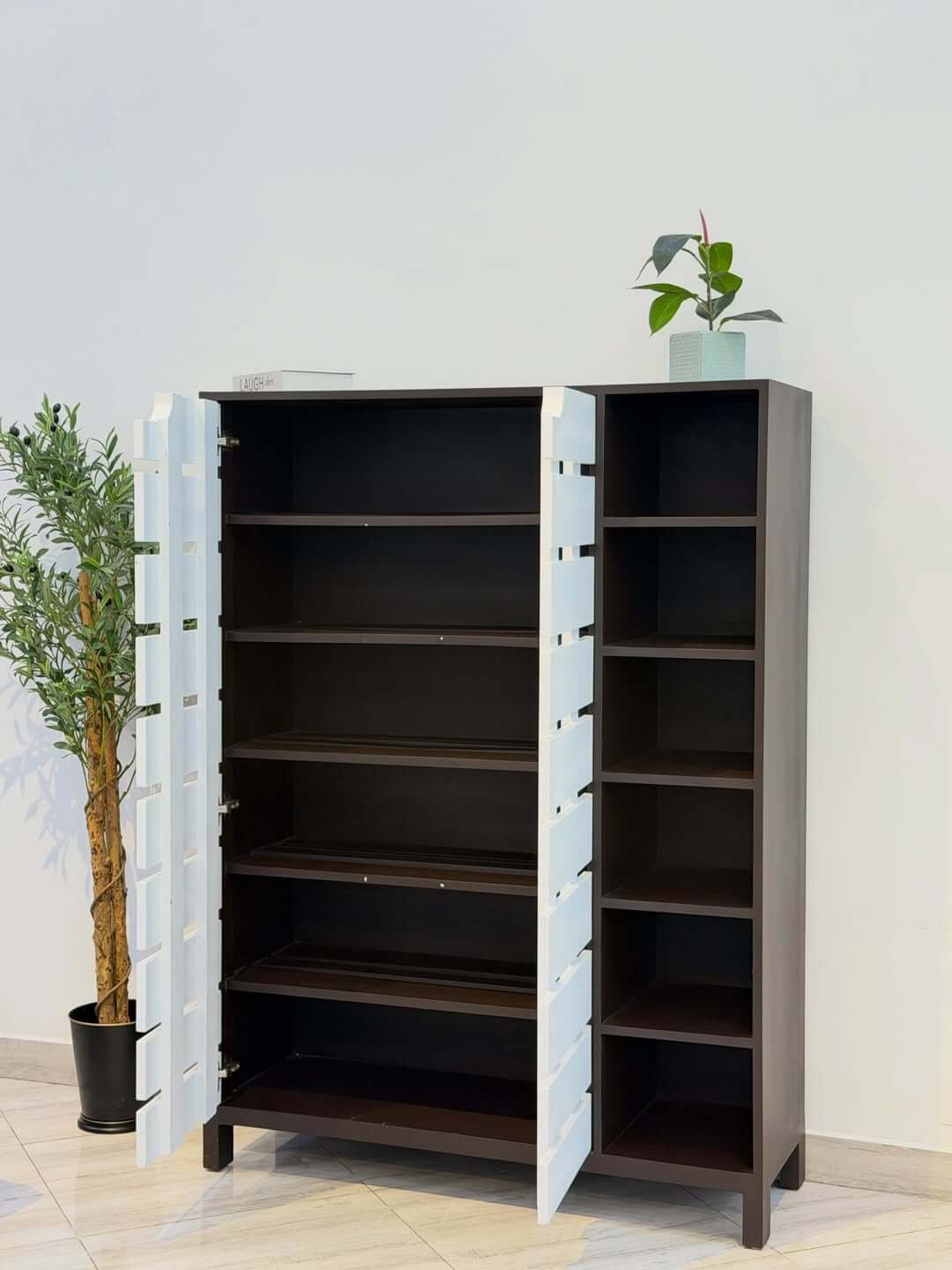
A slatted front with open side shelving — hidden storage for most pairs, open access for the daily ones.
Which wood is best for a shoe rack in Kenya?
If you are buying solid timber — or specifying wood for a custom build — the species affects colour, price and how the piece copes with wet shoes.
Teak
Naturally oily and dense, teak handles humidity better than almost any furniture timber, which is exactly what you want in a piece that receives rain-soaked shoes.1 It carries a warm golden-brown tone that deepens with age.
Mvule (African teak)
Mvule (Milicia excelsa) is East Africa’s own heavyweight, valued for exceptional strength and natural resistance to decay and water thanks to the oils in the timber.2 It is the toughest option for a busy family entryway.
Mahogany
The classic cabinet wood — deep reddish-brown, fine-grained, stable and easy to work into detailed doors and mouldings.2 Choose it when you want the shoe cabinet to match other dark timber furniture.
Meru oak
A lighter, characterful grain that stands up well to moisture — Kenyan furniture guides recommend it for pieces exposed to water.2 A good middle option on both colour and cost.
| Wood | Colour | Key strength | Best for an entryway that… |
|---|---|---|---|
| Teak | Warm golden-brown | Natural oils resist moisture | Takes wet shoes regularly |
| Mvule | Golden-brown, deepens with age | Toughest; decay and water resistant | Serves a large, busy household |
| Mahogany | Deep reddish-brown | Fine grain; takes detail well | Must match dark timber furniture |
| Meru oak | Lighter, characterful | Attractive grain, water-tolerant | Wants a lighter, brighter finish |
Solid wood or wood-look? How to tell before you pay
This is the single most useful thing to know in this category, because “wooden” is used loosely. A well-made wood-look cabinet can look excellent and cost less — the problem is only when you pay solid-timber money for one.
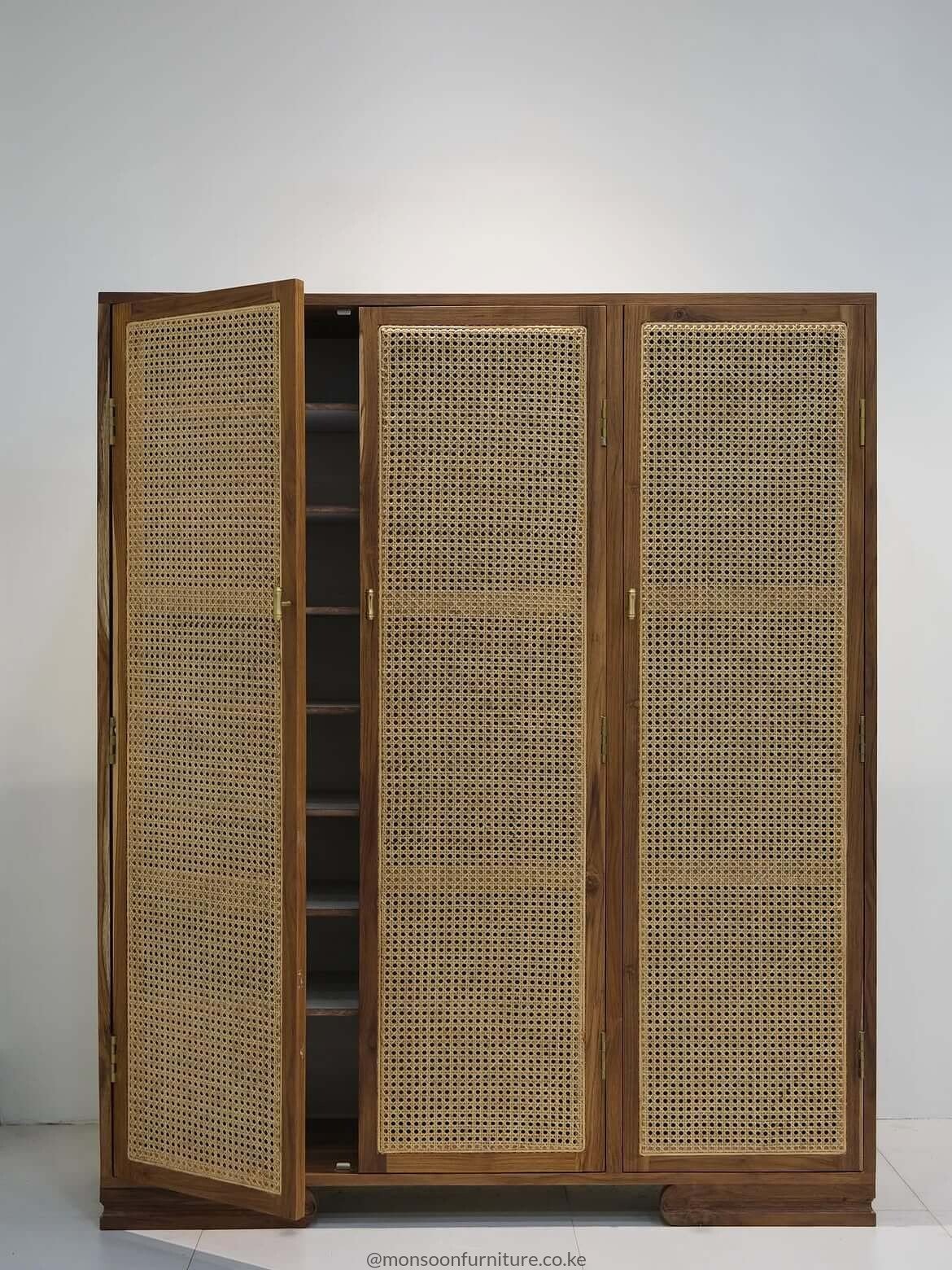
Left: a teak cabinet where the timber is the finish. Right: a painted cabinet — a different look and a different price, not a lesser one.
Four checks take about ten seconds in a showroom:
| Check | Solid wood | Wood-look board |
|---|---|---|
| Edges | Grain wraps continuously around | Finish stops at a seam; core visible |
| Back & underside | Looks like timber everywhere | Plain, smooth or paper-backed |
| Weight | Noticeably heavy to lift one end | Light for its size |
| Sound | Dense, solid knock | Hollow or dull |
The fastest check is to ask the seller which timber a piece is made from. A confident, specific answer (“teak”, “mahogany”) is a good sign. A vague one (“hardwood”, “imported wood”) usually means engineered board with a wood finish. On our own listings, the timber is named where it is confirmed and left unstated where it is not — you should expect that everywhere.
Wooden shoe rack prices in Kenya (2026)
Here is the honest price picture. These are current Monsoon figures at August 2026 and move with size, finish and promotions.
| Tier | What you get | Price (KES) |
|---|---|---|
| Open wooden-style rack | Tall open organiser or 6-tier rack, some with a drawer | 12,000 – 24,500 |
| Wood-finish cabinet | Tilt-out bins, fluted and panelled fronts, doors and drawers | 23,500 – 36,000 |
| Premium wood cabinet | Cane-door, woven-panel and teak cabinets with internal shelving | 43,000 – 49,000 |
| Custom in your chosen timber | Built to your hallway, shoe count and wood | Quoted on request |
The jump to the top tier buys three things: a named timber, more substantial construction, and door detailing — cane or woven panels — that is genuinely harder to make. Whether that is worth roughly KSh 15,000 over a good wood-finish cabinet depends on how long you intend to keep it. Our guide to shopping smart without compromising on quality sets out that trade-off across categories.
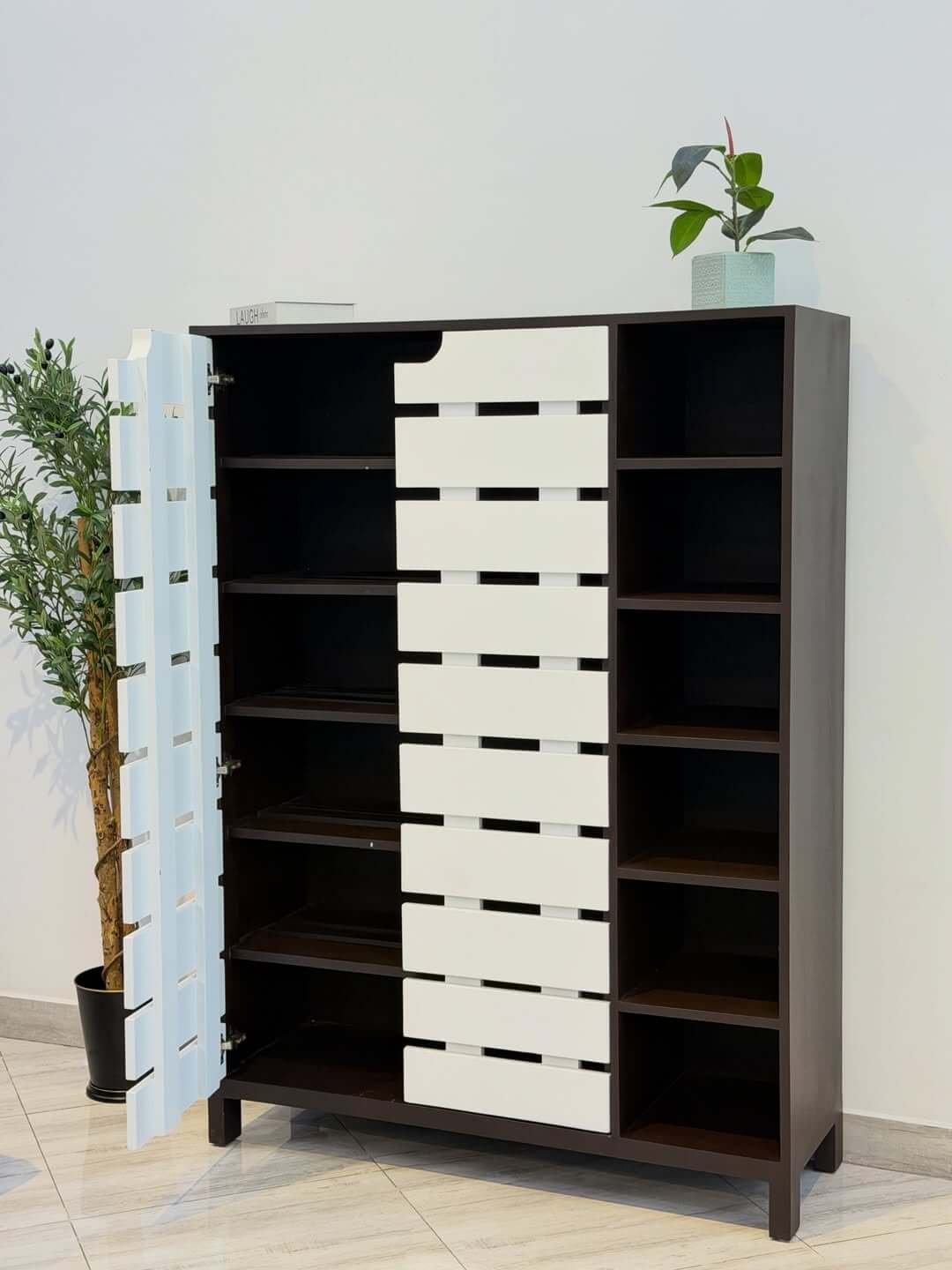
Height buys capacity without depth — the right shape for a narrow Nairobi hallway.
Caring for a wooden shoe rack in Kenya
Wood rewards very little effort with a very long life. The essentials for an entryway piece:
- Dust weekly with a dry or barely damp cloth — Nairobi dust is fine and abrasive if it builds up.
- Dry shoes first. Damp shoes in a closed wooden cabinet are the main cause of both odour and swollen shelves.
- Brush the weave. Cane and woven panels trap dust; a soft dry brush clears it without damaging the fibres.
- Keep it out of all-day sun, which fades timber tone unevenly over a year or two.
- Lift, don’t drag. Dragging a loaded cabinet across tiles stresses joints and marks the floor.
Can you order a custom wooden shoe rack?
Standard cabinets suit standard spaces. A 90cm corridor, an alcove beside the door, or a household with forty pairs is where a made-to-measure piece earns its price — built to the exact width, depth and shelf spacing you need, including taller tiers for boots.
- Send measurements. Corridor or wall width, available depth, and roughly how many pairs, on WhatsApp.
- Choose the timber and finish, along with open or closed fronts and shelf spacing.
- Approve the quote for your exact piece before any work begins.
- We build it in our Nairobi workshop, normally within 3–4 days.
- Delivery, free within Nairobi and available across Kenya.
A custom wooden rack also lets you match existing furniture — the same timber and finish as a wardrobe or console, so the entryway reads as one design rather than assembled pieces.
A wooden rack built to last
Browse wooden shoe racks and cabinets from KSh 12,000, or order a custom piece in your chosen timber — built in Nairobi, normally in 3–4 days, with free delivery in the city.
Frequently asked questions
How much is a wooden shoe rack in Kenya?
Wooden and wood-finish shoe racks in Kenya cost roughly KSh 12,000–49,000 in 2026. Simple open racks start near KSh 12,000, wood-finish cabinets run KSh 23,500–36,000, and premium cabinets with cane, woven or teak fronts reach KSh 43,000–49,000. Custom pieces in a chosen timber are quoted on request.
Which wood is best for a shoe rack in Kenya?
Teak and mvule are best because their natural oils resist the moisture that damp shoes bring into a cabinet. Mahogany offers the richest reddish-brown colour and a fine, workable grain, while Meru oak gives a lighter, attractive grain with good water tolerance. All four last far longer than board or plastic.
How can I tell if a shoe rack is solid wood or wood-look?
Check the edges, the back and the weight. Solid timber shows grain wrapping continuously around every edge and looks like wood underneath; wood-look board shows a printed finish stopping at a seam and a plain rear. Solid wood is heavy and knocks densely. Asking which timber it is should get a specific answer.
Can I order a custom wooden shoe rack in Kenya?
Yes. Monsoon builds custom wooden shoe racks to your hallway width, shoe count, timber and finish. Pieces are made in our Nairobi workshop, normally within 3–4 days, with free delivery inside Nairobi. Send your measurements and a photo of the space on WhatsApp for a quote before any work starts.
Sources:
1. Furniture-timber references on teak’s natural oil content and its performance in humid conditions.
2. Kenyan timber and furniture guidance on mvule (Milicia excelsa), mahogany and Meru oak — grain, colour and water resistance.
Prices current at August 2026 and subject to change. Timber is named only where the material is confirmed on the product listing; where a listing does not state a species, none is claimed here.

Add a review
Your email address will not be published. Required fields are marked *