
Shoe Rack vs Shoe Cabinet vs Storage Bench: Which to Choose in Kenya
Most people buy the wrong one — not because they chose badly, but because they never realised there were three answers. An open rack, a closed cabinet and a storage bench all solve “the shoes are everywhere”, but they solve it for different households, different corridors and different routines.
This guide compares all three properly: on access, appearance, airflow, footprint and price, with a 30-second decision rule at the end.
The three options at a glance
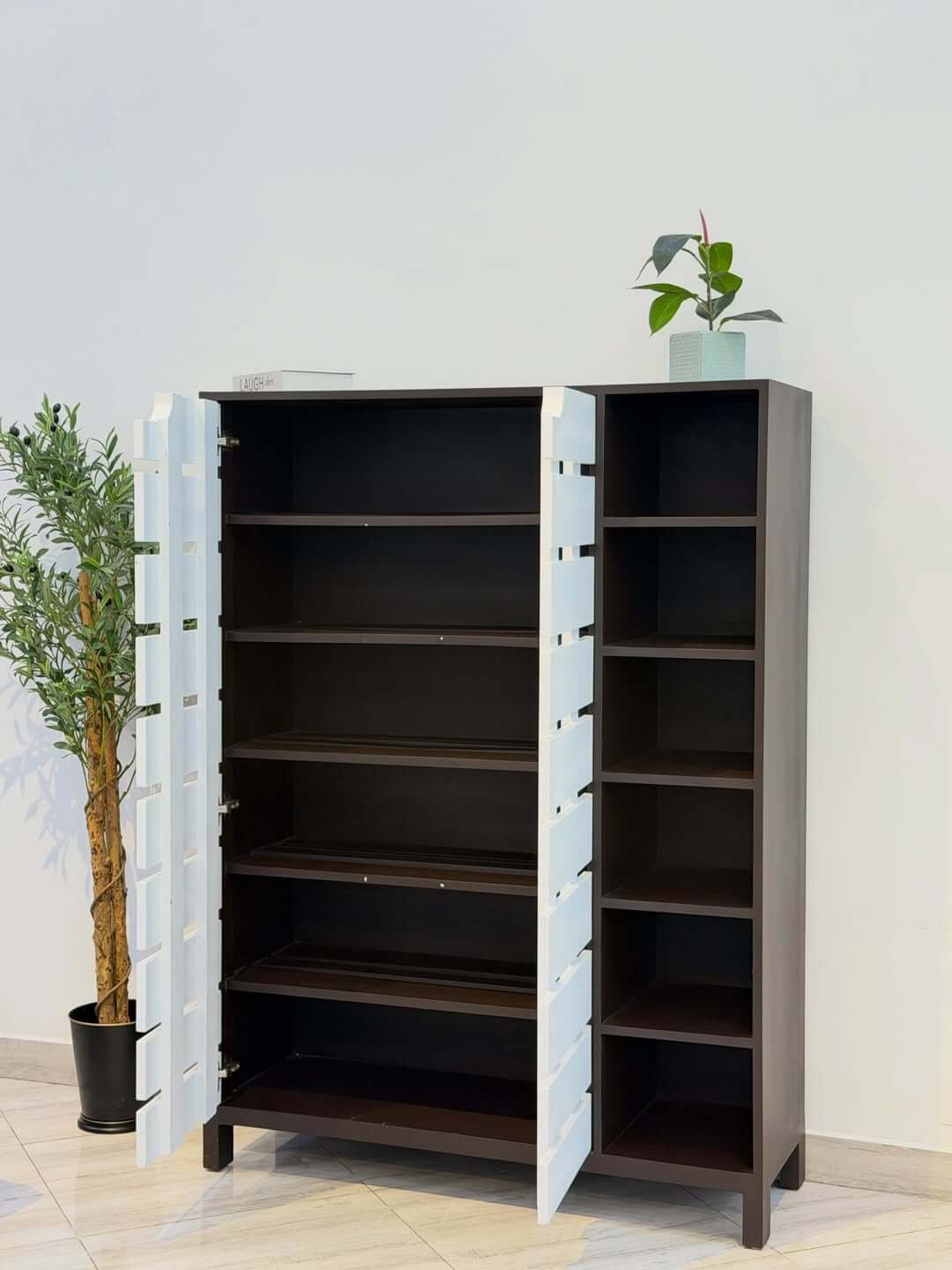
Open rack
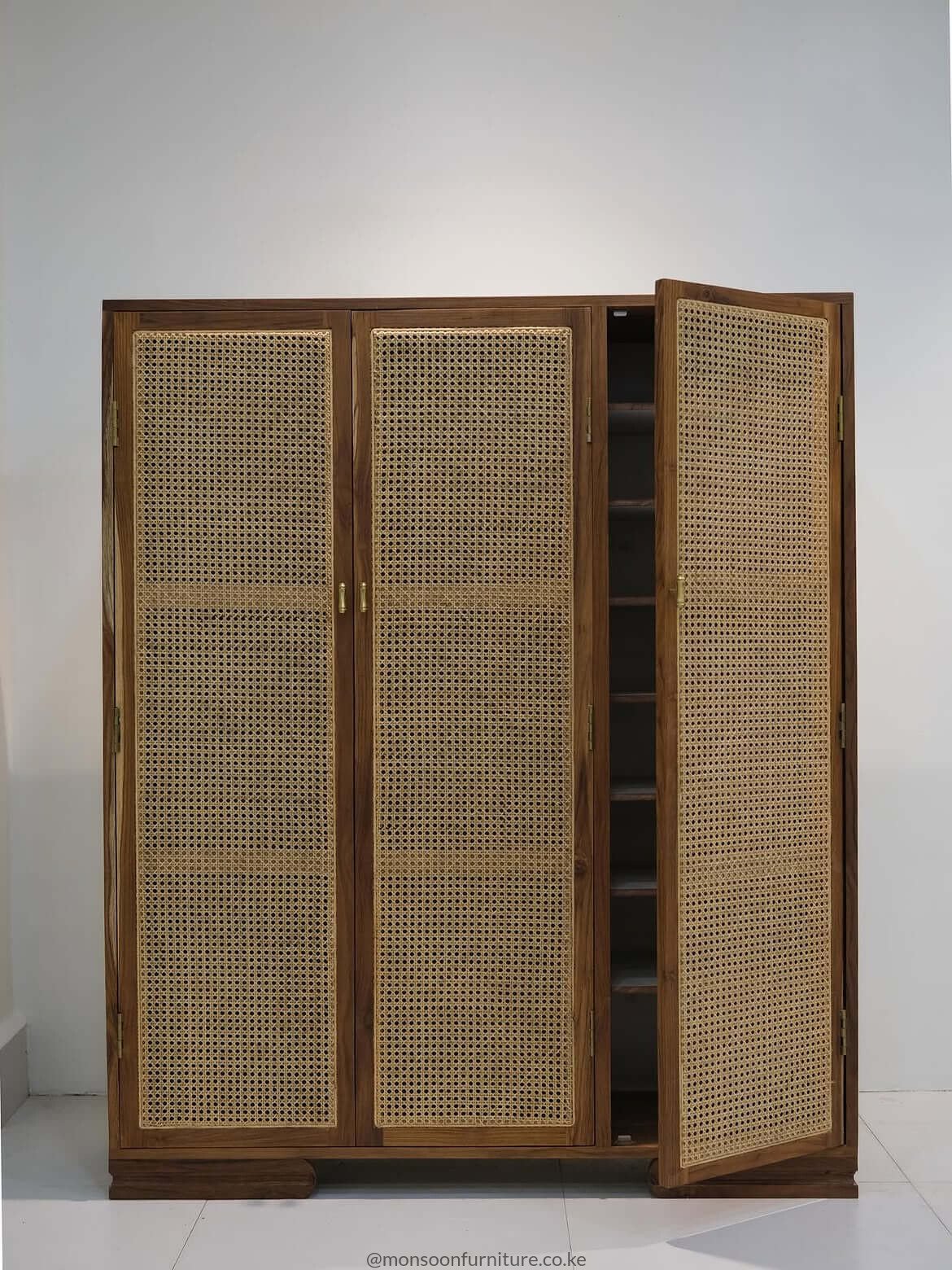
Cabinet
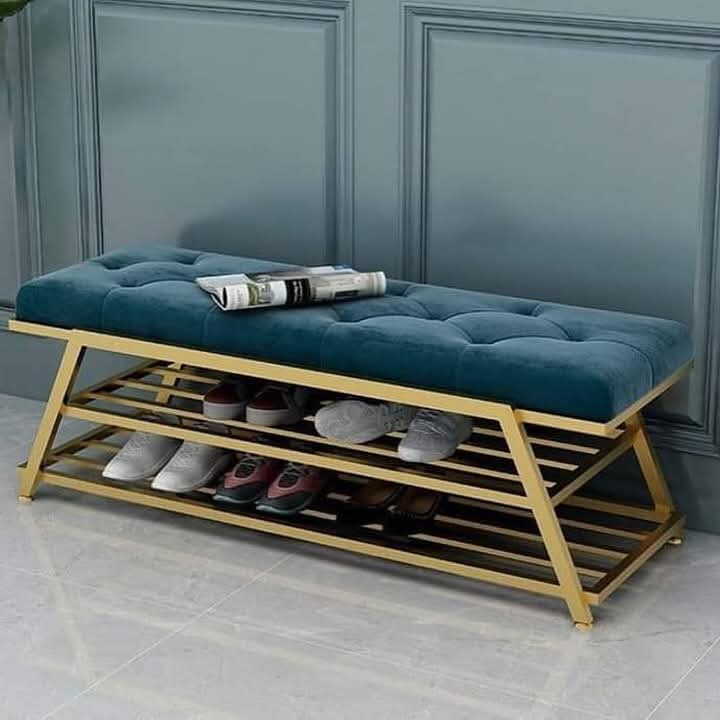
Bench
The same problem, three answers: shoes on show, shoes hidden, or shoes plus somewhere to sit.
| Open rack | Cabinet | Bench | |
|---|---|---|---|
| Access | Instant | One extra step | Instant |
| Look | Shoes on display | Cleanest — hidden | Seating, shoes part-visible |
| Airflow | Best | Needs vents or weave | Good — usually open below |
| Capacity | ~9–24 pairs | ~12–30+ pairs | ~6–14 pairs |
| Seating | No | Only “with seat” models | Yes |
| Dust protection | None | Good | Limited |
| Price (KES) | 12,000 – 24,500 | 23,000 – 49,000 | 14,000 – 28,000 |
Which suits your shoe count?
Capacity is the first filter, and it is where benches lose. A bench gives you seating, but the storage underneath is a single tier — usually six to fourteen pairs. That is fine for a couple; it is not a family solution on its own.
| Your shoe count | Best choice | Why |
|---|---|---|
| Under 10 pairs | Open rack or bench | Capacity is not the constraint — pick on looks and seating |
| 10–20 pairs | Cabinet | Enough shoes that visible storage starts to look cluttered |
| 20+ pairs | Tall cabinet | Only vertical closed storage keeps this tidy |
| Mixed household | Cabinet + bench | Bulk hidden, daily pairs and seating at the door |
Which suits your space?
Depth decides more than width in a Kenyan apartment. An open rack holds shoes lying flat, which sets its depth at roughly a shoe’s length. A tilt-out cabinet stands them nearly upright, so it can sit much shallower against the wall while holding more.
A bench is naturally shallow and low, which is why it works in corridors where a tall cabinet would feel oppressive — but remember you also need room to actually sit on it.
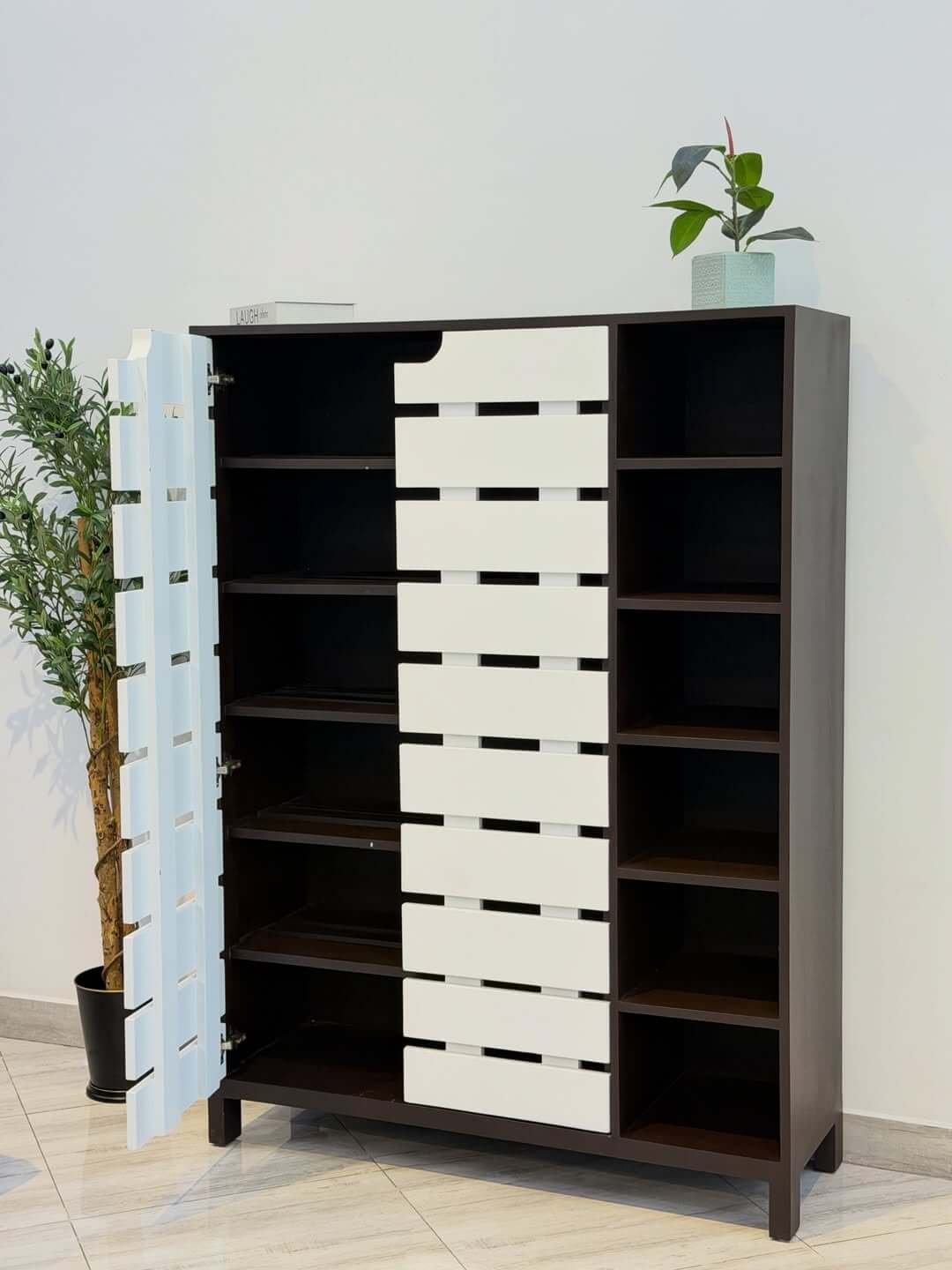
In a tight corridor the answer is height, not depth — storage that builds upwards and leaves the walkway clear.
Which suits your household’s routine?
This is the filter buyers skip, and it is often the deciding one. Three common situations:
- A busy family morning. Four people, one doorway, everyone in a hurry — open shelving keeps things moving.
- A front door that opens into the living room. The entryway is part of the room, so hidden storage protects the look of the whole space.
- Young children, older relatives, or anyone who sits to change. Balancing on one leg in a corridor is the problem a bench quietly solves.
Stand in your entryway and put on a pair of shoes the way you normally would. If you leaned on a wall or perched on the stairs, a bench will get used every single day. If you were in and out in five seconds, seating would just take up space you could give to storage.
What about damp shoes?
In the long rains this stops being theoretical. Shoes shut damp into a sealed cabinet stay damp for days, and that is what produces the musty smell people blame on the furniture.1
The fix is design, not deodoriser. Slots, slats and woven cane inserts all let air move through a closed unit — which is why those fronts are so common here. A cabinet with an open lower shelf is the best of both: hidden storage for most pairs, an airing spot for today’s.
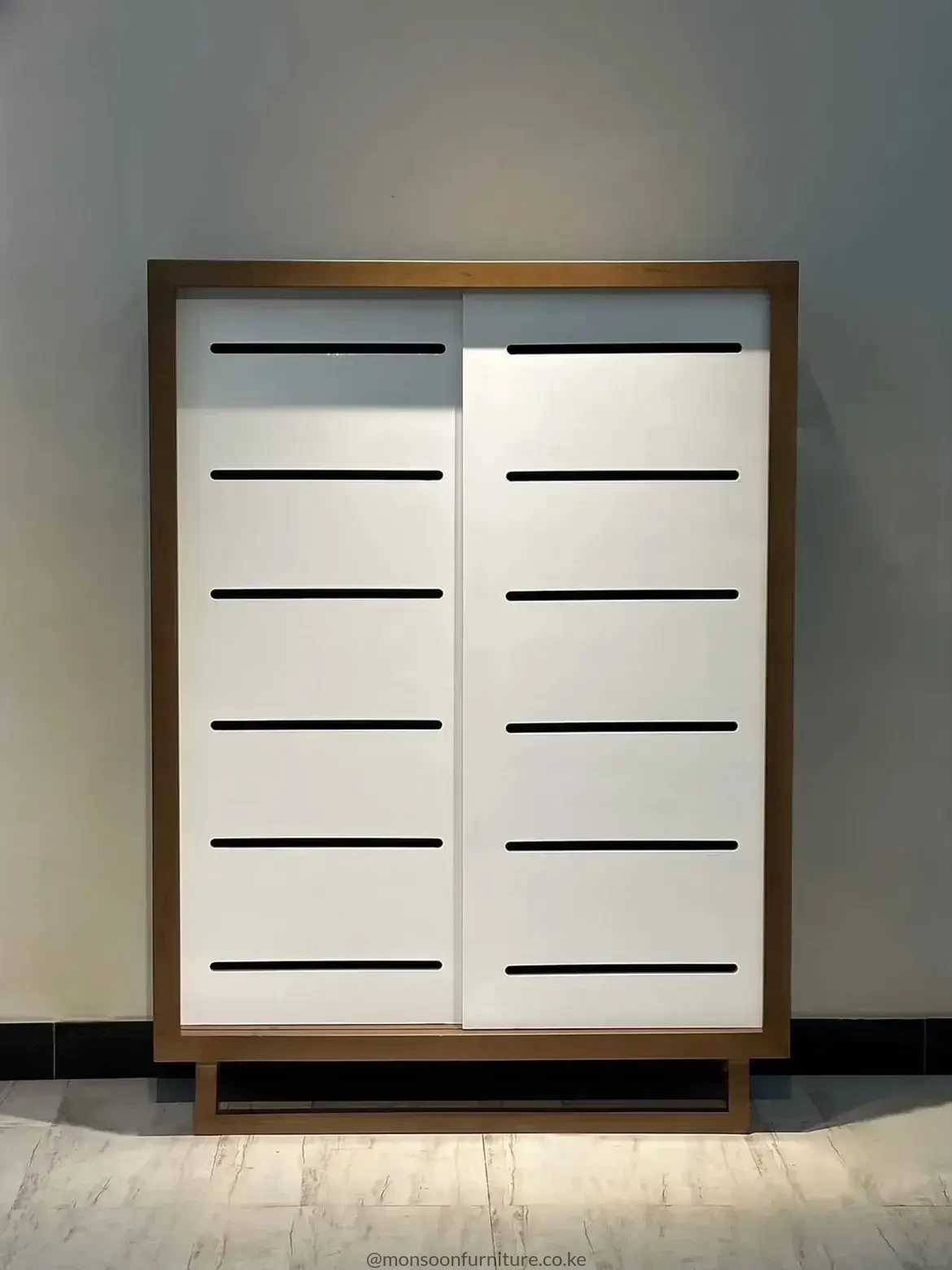
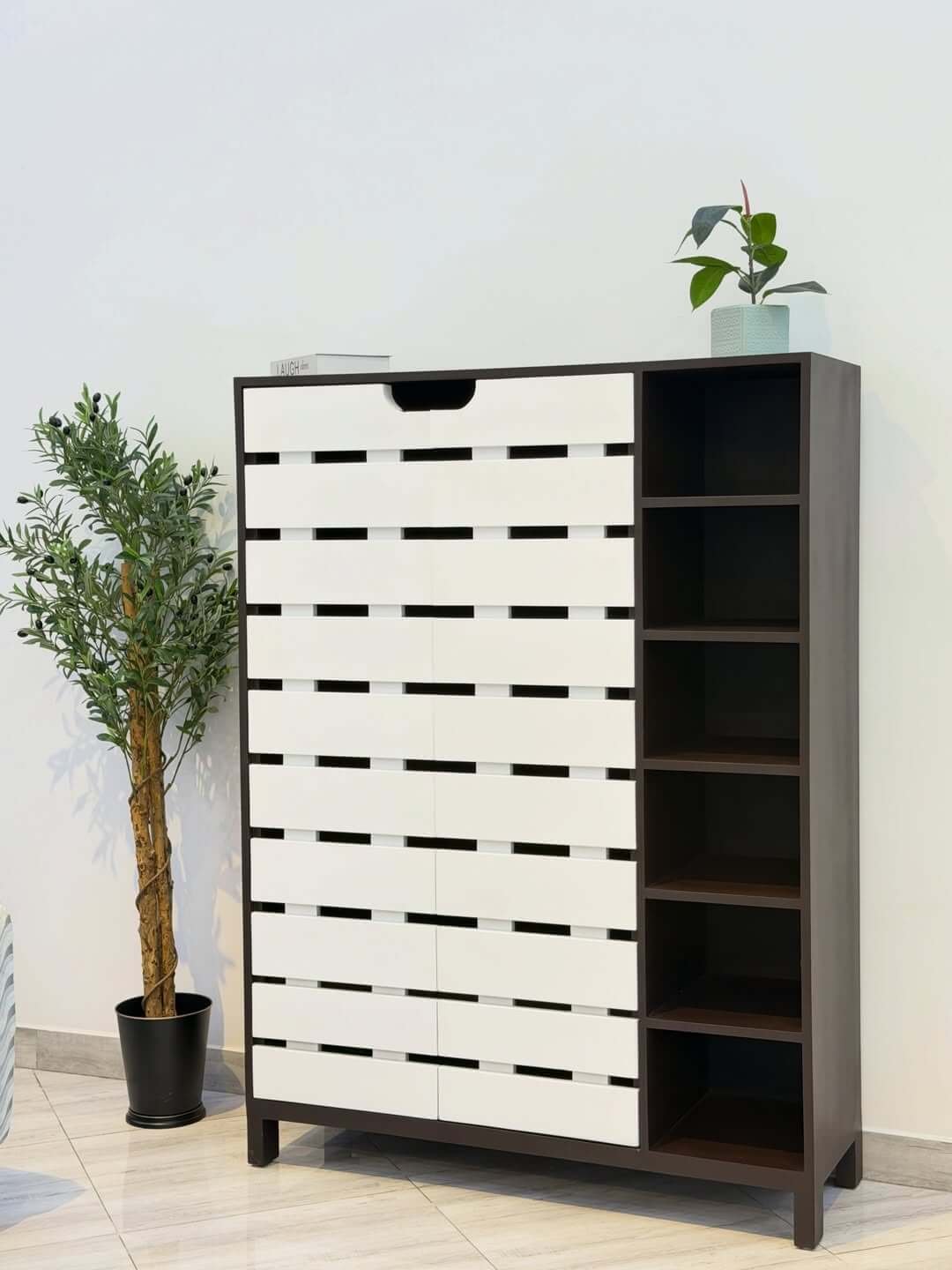
Ventilation slots cut into the front — how a closed cabinet keeps the airflow of an open rack.
Price compared
| Option | Entry | Typical | Premium |
|---|---|---|---|
| Open rack | 12,000 | 21,000 – 24,500 | 24,500 |
| Storage bench | 14,000 | 16,000 – 18,000 | 24,500 – 28,000 |
| Shoe cabinet | 23,000 | 28,000 – 36,000 | 43,000 – 49,000 |
The useful takeaway: a bench costs about the same as a mid open rack, so if you want seating you are not paying a real premium for it. The genuine step up in price is the cabinet — and what you are buying there is concealment and capacity. For the detail on cabinet types and what each tier includes, see our guide to shoe cabinets in Kenya.
Can you combine them?
Most Kenyan entryways do not need a pure version of any of the three. Three hybrids worth knowing:
| Hybrid | What it gives you |
|---|---|
| Cabinet with a seat | Hidden storage plus seating in one footprint |
| Cabinet with an open lower shelf | Daily shoes to hand, the rest out of sight and airing space for damp pairs |
| Cabinet plus separate bench | Maximum capacity and comfortable seating, for wider entrances |
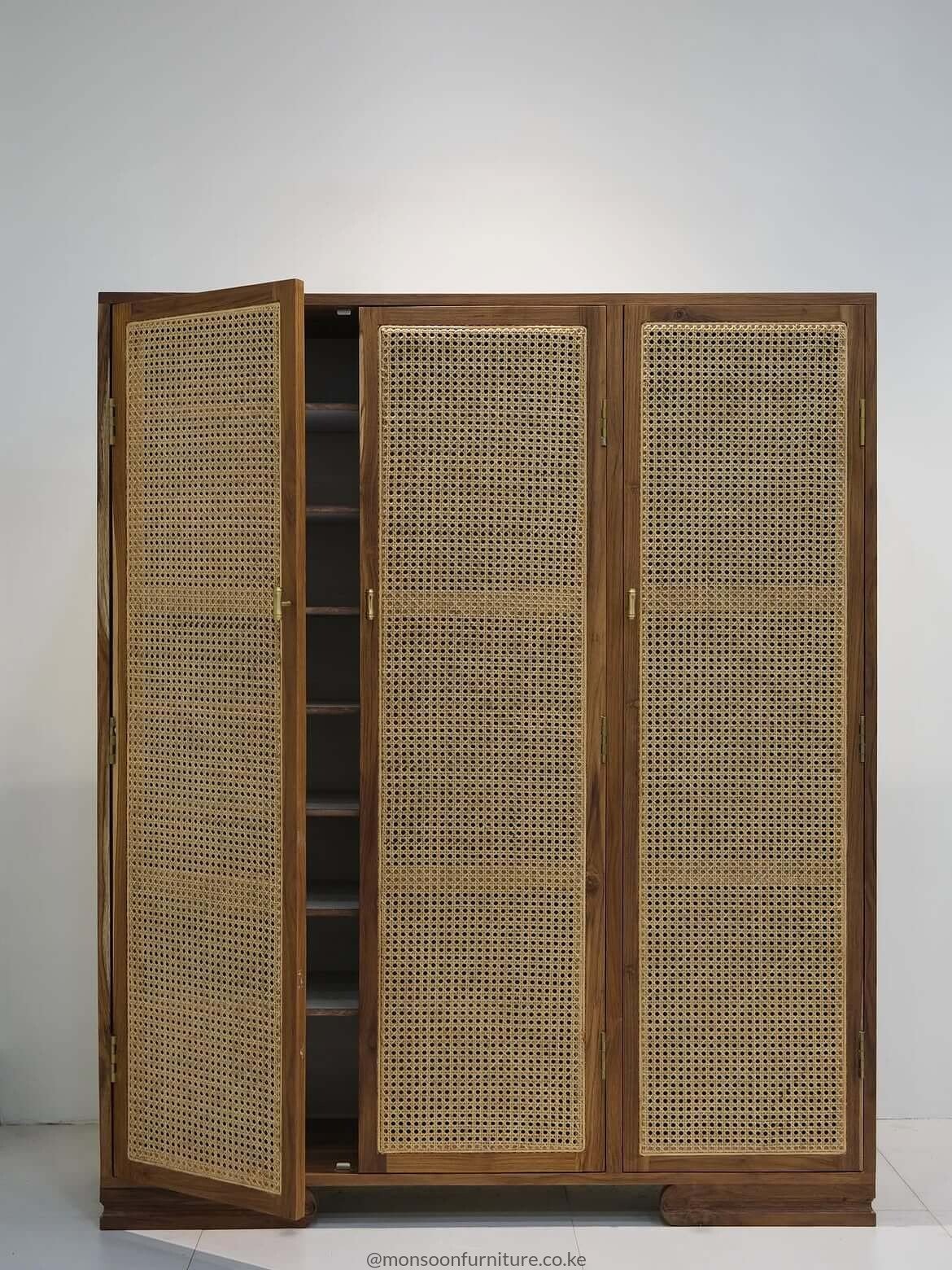
Closed doors for the bulk of the collection, open shelving for what you wear this week.
The 30-second decision
Answer these in order and stop at the first yes:
- Does your front door open straight into the sitting room? → Cabinet. The entryway is part of the room you entertain in.
- Do you own more than ten pairs? → Cabinet. Visible storage stops looking tidy past that point.
- Do shoes often come in wet or muddy? → Open rack, or a ventilated cabinet with an open lower shelf.
- Do several people leave the house at the same time? → Open rack. Nobody waits for a door.
- Do you sit down to put shoes on? → Bench, or a cabinet with a built-in seat.
- Is the corridor under a metre wide? → Slim tilt-out cabinet or a low bench, never a deep open rack.
If you want the fuller picture on materials, capacity and every rack format before deciding, start with our main guide to shoe racks in Kenya, or read up on wooden shoe racks and how to spot a wood-look finish if timber matters to you.
Not sure which one? Ask us
Send a photo of your entryway and your rough shoe count on WhatsApp, and we’ll tell you which of the three actually fits — or build a custom piece in 3–4 days. Free delivery within Nairobi.
Frequently asked questions
Is a shoe rack or shoe cabinet better?
An open rack is better for fast daily access and for airing damp shoes. A cabinet is better for a clean, dust-free entryway and for larger collections. Under about ten pairs, a rack is usually enough; above ten, or where the front door opens into a living space, a cabinet is the stronger choice.
Is a shoe bench worth it?
A shoe bench is worth it if you sit down to put shoes on, or if your corridor has nowhere to perch. Benches cost KSh 14,000–28,000 in Kenya — about the same as a mid-range open rack — so seating adds little premium. They hold fewer pairs though, usually six to fourteen.
Which shoe storage is best for a small apartment?
For a small apartment, choose a slim tilt-out cabinet that stores shoes almost upright, or a low bench that doubles as seating. Both sit tight against the wall. Leave 70–80cm of clear walking space in front, and prefer height over depth so the corridor stays passable.
Can you get a shoe cabinet with a seat?
Yes. Cabinets with a built-in cushioned seat give hidden shoe storage and seating in one footprint, which suits entryways too narrow for both a cabinet and a separate bench. They start around KSh 23,000 in Kenya, and custom versions can be built to a specific hallway width.
Sources:
1. Footwear-care and shoe-storage guidance on ventilation, drying damp shoes before enclosed storage, and preventing odour and mildew.
Prices current at August 2026 and subject to change. Capacities are general planning guidance and vary with shelf spacing and shoe type.

Add a review
Your email address will not be published. Required fields are marked *