
TV Cabinet vs TV Stand vs Media Console: What’s the Difference?
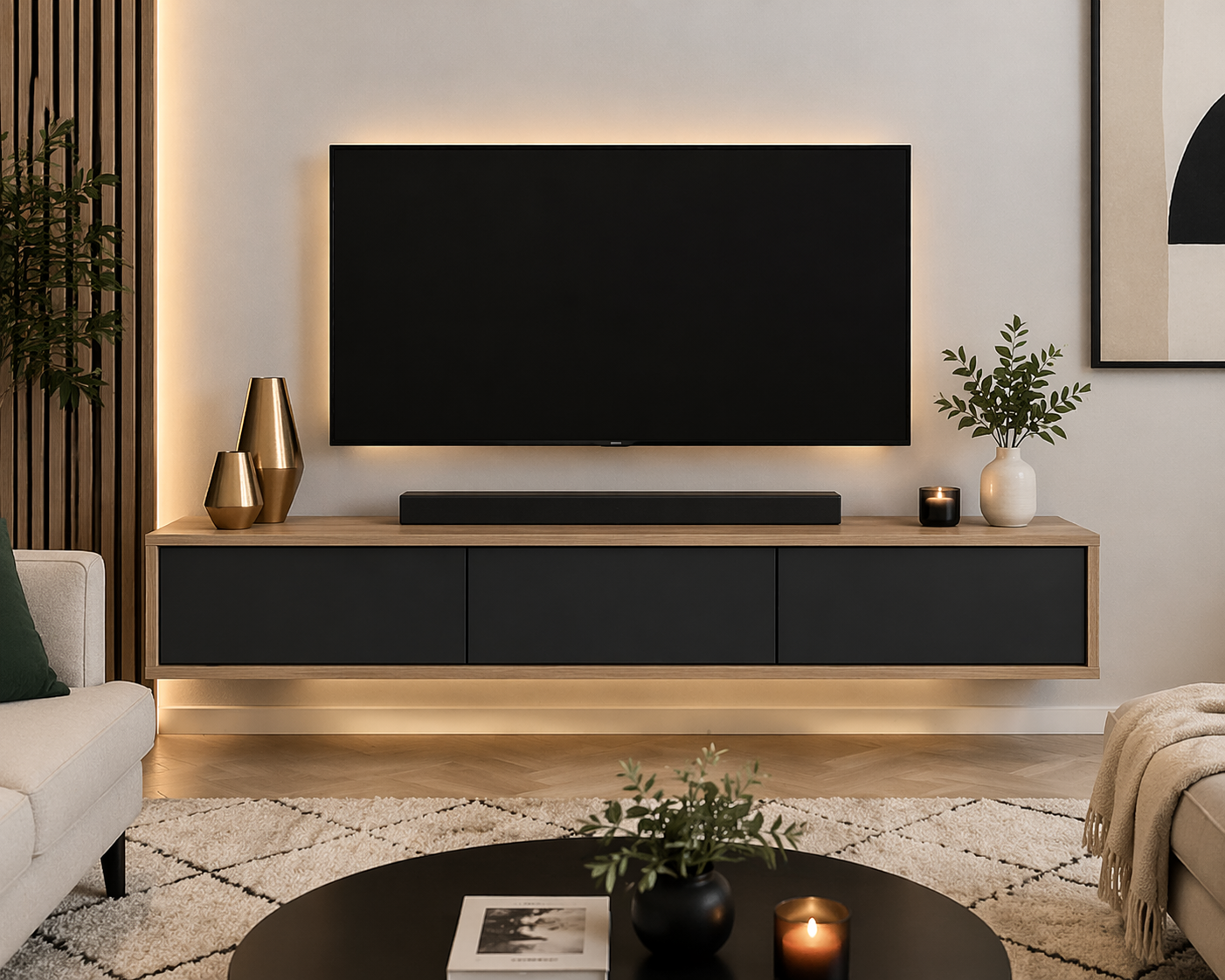
Search for a TV stand in Kenya and you will be shown TV cabinets, media consoles, TV units, entertainment centres and TV showcases — often on the same page, sometimes describing near-identical furniture. It is genuinely confusing, and most buyers assume they are missing a distinction everyone else understands.
They are not. This guide explains what each term loosely implies, why they blur together here, and — more usefully — the four attributes that actually differ between products.
What is a TV stand?
If a term here is a catch-all, this is it. “TV stand” is what most people search for, what most collections are named after, and what covers everything from a KSh 16,500 slatted unit to a large solid-wood media piece.
Loose implication: floor-standing, moderate length, at least some open shelving.
What is a TV cabinet?
The word “cabinet” carries a real hint: it suggests things are put away rather than displayed. A unit named a cabinet is more likely to have doors or drawers concealing the decoder and accessories.
But the hint is only a hint. Our own collection includes a 180cm wall-mounted piece called a TV cabinet that has both flip-down doors and an open shelf — which would equally justify being called a console.
Loose implication: more closed storage, tidier look.
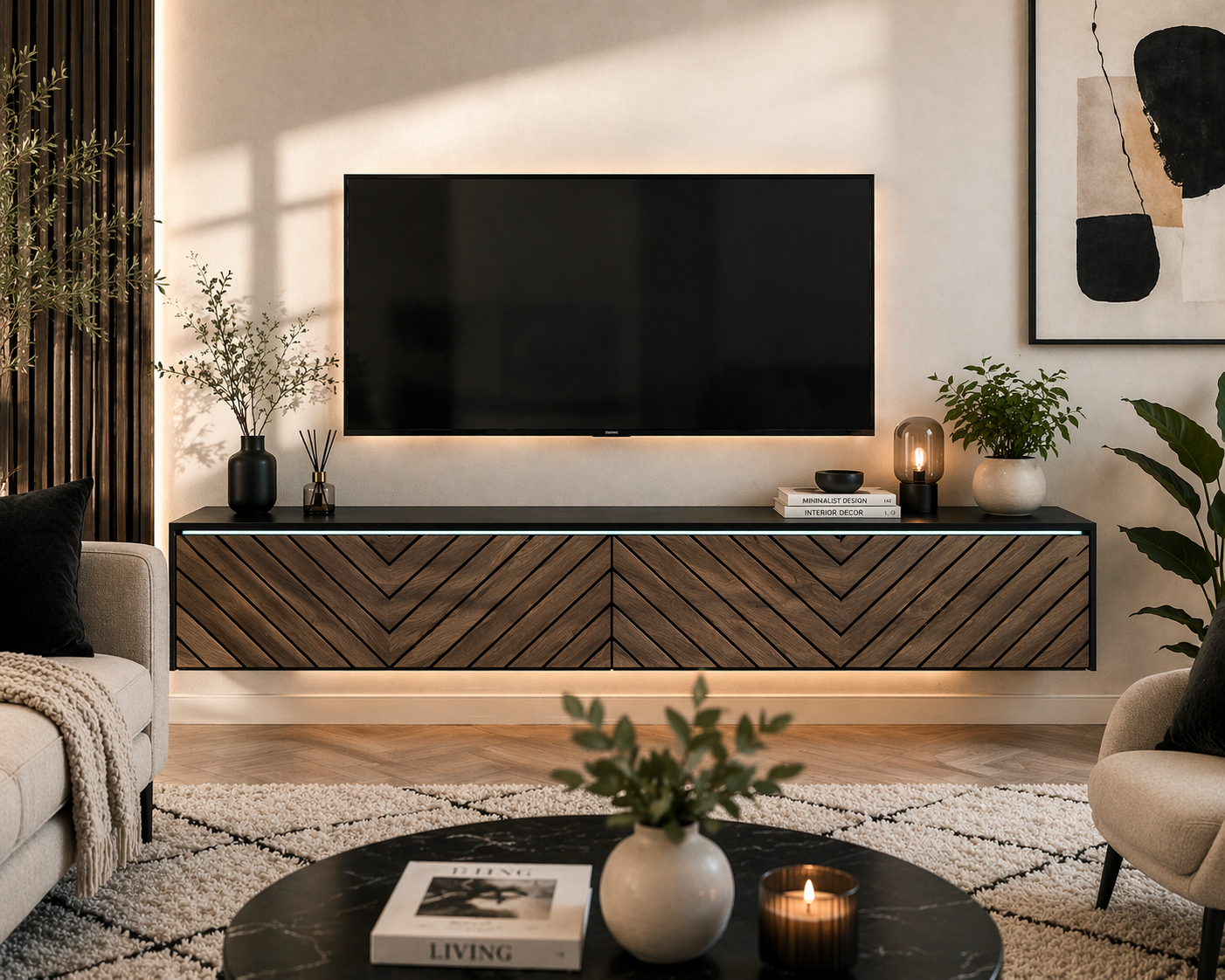
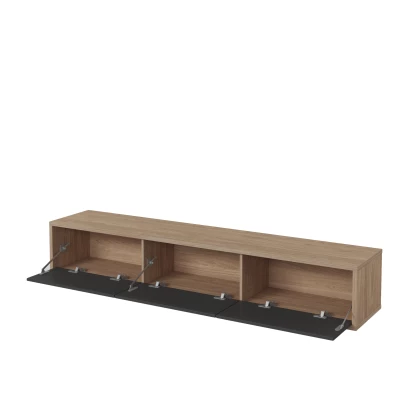
Open storage sections on the left, fully closed panels on the right — the difference that matters, whatever either one is called.
What is a TV console?
“Console” is the term that has grown fastest, because it matches the current look: long, low, low-profile, designed to sit under a mounted screen rather than support one on top.
It implies proportion more than function — a console is understood to be longer than it is tall, with a horizontal emphasis. Beyond that, consoles come with drawers, doors, open bays or all three.
Loose implication: long, low, horizontal, often paired with a wall-mounted TV.
Media units, entertainment centres and TV showcases
Three more terms, each nudging in a slightly different direction:
| Term | What it implies |
|---|---|
| Media unit / media console | Emphasis on equipment storage — decoder, soundbar, console |
| Entertainment centre | Larger, multi-section, sometimes with upper shelving |
| TV showcase | Display shelving for décor alongside the screen |
| TV unit | Neutral general term, common on imported furniture |
So what actually differs?
This is the honest answer, and it is more useful than any definition. We use several of these terms across our own collection, and so does every retailer in Kenya. The names are a language habit rather than a specification.
What to look at instead:
| Attribute | The options | Why it matters |
|---|---|---|
| Storage type | Open shelves · doors · drawers · mixed | Decides whether clutter shows and how fast you reach things |
| Proportion | Long and low · shorter and taller | Low suits mounted screens; taller suits TVs placed on top |
| Mounting | Floor-standing · wall-mounted | Wall-mounted frees floor space but needs a suitable wall |
| Length | Typically 120–240cm | Must exceed your TV’s width by 15cm on each side |
Cover the product name and look only at the photograph and dimensions. If you can tell what the unit does — open or closed, long or tall, floor or wall — you have everything you need. If the name changes your opinion of a piece you could already see clearly, the name is doing marketing work, not descriptive work.
Does the name affect the price?
Here is the overlap, taken from a single collection at August 2026:
| Named as… | Price range (KES) |
|---|---|
| TV stand | 16,500 – 21,000 |
| TV cabinet | 17,000 – 23,000 |
| TV unit | 18,000 |
| Media console / media cabinet | 19,500 – 35,000 |
| TV console | 18,000 – 46,000 |
The ranges sit almost on top of one another. What actually moves the price is length, whether the carcass is solid timber or board, how much closed storage and drawer hardware is involved, and the finish. Our comparison of solid wood versus MDF covers the material half of that.
Which should you buy?
Ignore the names and answer four questions:
- Will the TV sit on it, or be mounted above? Mounted screens suit long low consoles; a TV standing on the unit needs a sturdier top and often more height.
- Do you want the decoder visible? Open bays keep remote signals simple; closed doors look tidier but may need signal-friendly fronts.
- How much do you need to hide? Drawers earn their place in family rooms where remotes, cables and game controllers accumulate.
- Floor or wall? Wall-mounted frees the floor, but only works on a suitable wall — see our guide to floating TV stands.
Then check the length against your television using our TV stand size conversion guide, since Kenyan listings mix feet and centimetres.
What to ask a seller
A seller who answers those four clearly is describing the product. A seller who returns to the category name is not.
For a full walk through designs, timbers and what to look for, start with our guide to wooden TV stands in Kenya.
Tell us what you need it to do
Send your TV size, wall measurement and whether you want storage open or hidden — we’ll point you to the right unit, whatever it happens to be called. Free delivery within Nairobi.
Frequently asked questions
What is the difference between a TV stand and a TV cabinet?
There is no strict definition. “TV cabinet” loosely implies more enclosed storage — doors, drawers or flip-down fronts — while “TV stand” is the broader category term and often suggests open shelving. In practice Kenyan retailers use both names for similar furniture, so judge by the storage layout rather than the label.
What is a TV console?
A TV console usually describes a long, low unit with a clean horizontal profile, often 150cm or more, designed to sit beneath a wall-mounted television. The term implies proportion rather than a specific function — consoles come with drawers, doors, open bays or a combination of all three.
Is a media unit the same as a TV stand?
Effectively yes. “Media unit” and “media console” emphasise storage for equipment such as decoders, sound systems and consoles, but they describe the same category of furniture as a TV stand. The difference is emphasis in the name, not a difference in what the product does.
Does a TV cabinet cost more than a TV stand?
Not reliably. In Kenya, price tracks length, material, storage complexity and finish rather than the category name. Units named TV stand, TV cabinet, TV console and media unit all overlap heavily in price — a console can cost less than a cabinet, and a stand more than either.
Price ranges are drawn from a single Kenyan collection at August 2026 and are illustrative of how the categories overlap rather than a market-wide survey. Terminology described here reflects common Kenyan retail usage, which is not standardised across the industry.

Add a review
Your email address will not be published. Required fields are marked *